There are moments in a building’s life when its entire fire suppression infrastructure goes dark. Sprinklers offline. Alarm panels blinking red. And somewhere in that gap between vulnerability and catastrophe stands a single trained professional whose entire job is to make sure nothing burns. Fire watch guards are not a footnote in fire safety planning — they are the living, breathing contingency that keeps buildings, workers, and communities safe when automated systems simply cannot.
That role is more critical than most people realize. And as urban construction accelerates, fire code enforcement tightens, and the consequences of noncompliance grow steeper, the fire watch industry is stepping into a spotlight it has long deserved.
When Technology Fails, Humans Step In
Modern buildings are marvels of automated fire protection. Networked sprinkler systems, intelligent smoke detectors, real-time fire alarm monitoring — the engineering is genuinely impressive. But every system has a vulnerability window. A sprinkler system pulled offline for maintenance. An alarm panel undergoing repairs after a power surge. A newly constructed structure where fire suppression hasn’t yet been commissioned.
These windows don’t announce themselves with warning bells. They open quietly, often in the middle of a workday or overnight, and they can last hours — sometimes days. That’s precisely where fire watch services become non-negotiable.
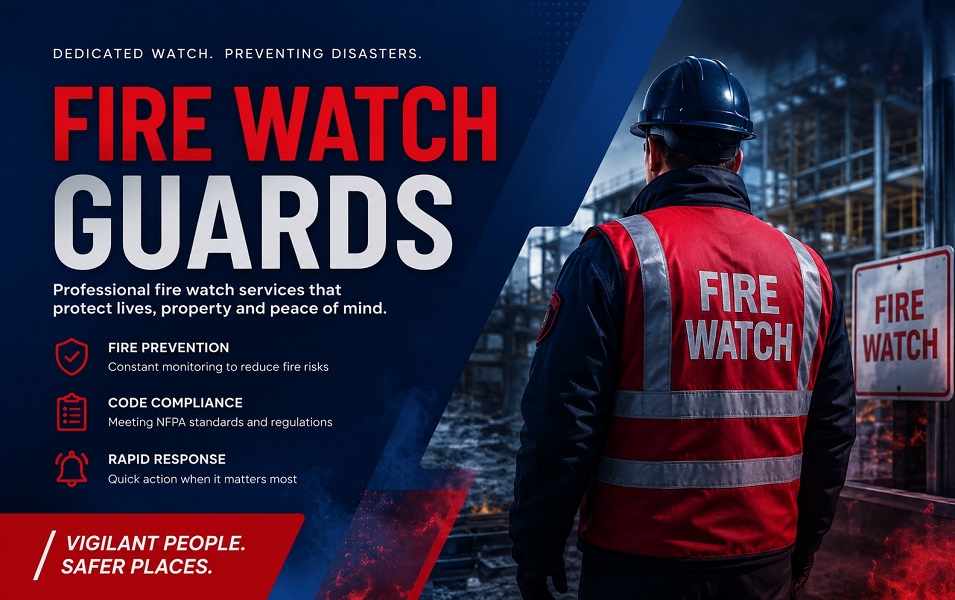
A trained fire watch guard doesn’t just patrol corridors with a clipboard. They are a mobile early-detection system, a first responder in embryonic form, and a compliance officer rolled into one. They scan for ignition sources, monitor hot work operations, document hourly rounds, and are trained to initiate emergency protocols the moment something looks wrong. In high-stakes environments — hospitals, data centers, high-rise residential towers, film production sets — that human layer of protection is often the only thing standing between a smoldering incident and a full structural loss.
The Regulatory Backbone That Drives Demand
Fire watch isn’t a suggestion. It’s law.
The National Fire Protection Association (NFPA), particularly NFPA 101 and NFPA 25, along with the International Fire Code (IFC), mandates fire watch deployment when fire protection systems are impaired beyond a specific duration — typically four hours or more within a 24-hour period. Local fire marshals and Authorities Having Jurisdiction (AHJs) enforce these codes with increasing rigor, and the penalties for noncompliance can include immediate occupancy shutdowns, steep fines, and in extreme cases, criminal liability following an incident.
Construction sites face an especially dense web of requirements. Hot work permits — covering welding, cutting, grinding, and torch operations — frequently trigger mandatory fire watch coverage for up to an hour after work concludes. The reason is simple physics: smoldering materials can reignite well after a flame source is removed.
Savvy building owners and construction managers no longer treat fire watch as a reactive measure. They build it into project timelines from day one, engaging professional fire watch companies before impairment windows even open. That shift in mindset — from reactive to proactive — is quietly reshaping how the industry operates.
What Separates Professional Fire Watch from Amateur Hour
Not all fire watch coverage is created equal. This is a distinction the industry is pushing hard to clarify, and for good reason.
A security guard handed a flashlight and told to “watch for fire” is not a fire watch guard. Professional fire watch personnel undergo specific training in fire behavior, emergency communications, evacuation procedures, fire extinguisher operation, and documentation protocols. They understand how fires ignite, how they spread, and — critically — how to buy critical minutes before a fire department arrives.
Companies like Just Fire Watch have built their entire operational model around this professional standard. Rather than offering fire watch as an upsell to general security services, specialized fire watch providers bring focused expertise, dedicated training programs, and industry-specific accountability. Their guards know NFPA codes. They understand impairment logs. They know what a properly completed fire watch report looks like and why it matters in a post-incident investigation.
The documentation piece deserves particular emphasis. In the event of a fire, every entry in a fire watch log becomes evidence. Timestamps, patrol routes, observations, equipment checks — these records can determine whether an insurance claim is honored, whether a contractor is held liable, or whether a building owner faces legal exposure. A professional fire watch company treats that paperwork with the seriousness of a legal document. Because it is one.
High-Stakes Environments Where Fire Watch Is Non-Negotiable
Consider the operational reality of a Level 1 trauma center undergoing a major HVAC renovation. The sprinkler system in two wings is offline for 72 hours. Patients can’t be evacuated. Surgery doesn’t stop. In that environment, the fire watch team isn’t a cost — it’s the only thing making continued operations legally and ethically defensible.
Or picture a mixed-use high-rise in downtown Chicago where a fire alarm panel is being replaced after storm damage. Seven hundred residents sleep in that building every night. The building management has two choices: halt occupancy until the panel is restored, or deploy a certified fire watch team that meets fire marshal requirements and allows the building to remain occupied.
Film and television production sets represent another underappreciated demand sector. Pyrotechnics, high-intensity lighting, diesel generators, densely packed equipment, and temporary structures create a fire environment that permanent building systems aren’t designed to address. Professional fire watch coverage on sets isn’t just about insurance compliance — it’s about protecting crews working in environments that evolve by the hour.
Industrial facilities, refineries, shipyards, and warehouses housing flammable materials round out the picture. In these environments, a single ignition event can cascade into a multi-million-dollar loss within minutes. The ROI on professional fire watch coverage isn’t hard to calculate.
The Business Case for Investing in Certified Coverage
There’s a financial argument for fire watch that rarely gets made explicitly, but it’s compelling.
The average commercial fire loss in the United States runs into hundreds of thousands of dollars before factoring in business interruption, legal liability, and reputational damage. Property insurers are acutely aware of this math, and many now require documented fire watch coverage as a condition of maintaining coverage during system impairments. Failing to deploy certified fire watch — or deploying undertrained personnel — can void a policy entirely.
That’s a catastrophic exposure. And yet some building owners still approach fire watch as a budget line to minimize rather than a risk management investment to optimize. The smarter operators — the ones who’ve sat through a post-incident review or watched a neighbor’s building go dark for months after a preventable fire — understand the calculus differently.
Professional fire watch services from dedicated providers are often more cost-effective than they appear when measured against the full risk picture. A 24-hour fire watch deployment might cost a fraction of one day’s business interruption insurance claim. It’s asymmetric protection in the best possible sense.
The Human Factor in an Automated World
There’s something philosophically interesting about the fire watch profession in an era defined by automation. While sensors get smarter and AI-driven building management systems grow more sophisticated, the fire watch guard remains irreplaceable — not despite the technology, but because of it.
Automated systems are extraordinarily good at doing exactly what they’re programmed to do. They are less good at adapting to novel situations, making judgment calls in ambiguous conditions, or communicating nuanced risk to a building occupant who speaks a different language. A trained human being does all of those things instinctively.
The guard who notices that a contractor left combustible materials too close to a heat source isn’t responding to a sensor alert. They’re applying pattern recognition, professional training, and situational awareness to a scene that no algorithm has been trained to flag. That judgment is the product of experience and deliberate training — and it cannot be downloaded or automated away.
As buildings grow more complex and fire codes grow more demanding, the professional fire watch guard isn’t becoming obsolete. They’re becoming more essential. The gap between what automated systems can reliably cover and what real-world fire risk actually looks like is wide enough to drive entire careers through — and wide enough, in the wrong circumstances, for a fire to grow unchecked.
Choosing the Right Fire Watch Partner
For building owners, facility managers, and construction site supervisors evaluating fire watch options, a few distinctions cut through the noise.
Specialization matters. A company whose primary business is fire watch — not general security with fire watch as a side service — brings a depth of code knowledge, training rigor, and operational focus that generalist providers rarely match. Ask directly: do your guards receive NFPA-specific training? How are logs documented and stored? What’s your response protocol when a guard identifies an active threat?
Availability is equally critical. Fire system impairments don’t follow business hours. A fire watch provider that can deploy certified personnel within hours, at any time of day or night, is a fundamentally different resource than one operating on a nine-to-five schedule.
Local market knowledge rounds out the evaluation. An experienced fire watch company knows the preferences of local fire marshals, understands how AHJs in specific jurisdictions interpret ambiguous code language, and can help clients navigate compliance requirements without unnecessary friction. That institutional knowledge has real operational value.
The buildings that never make the news — the ones that didn’t burn, the ones where an impairment window closed without incident — are the buildings where someone made the right call before the emergency began.
That’s the fire watch guard’s greatest achievement: the fire that never happened.